
Bilingual Education
2026.01.12
LTTC Hosts a Lecture on Assessing Second Language Interactional Competence in the Digital Age
Professor Carsten Roever from the University of Melbourne, Australia, was invited by the Language Training and Testing Center (LTTC) to deliver a talk entitled "Assessment of L2 Interactional Competence in the Digital Age" on the morning of January 5, 2026. In the lecture, Professor Roever shared his expert insights into research on second language interactional competence and its implications for language assessment.
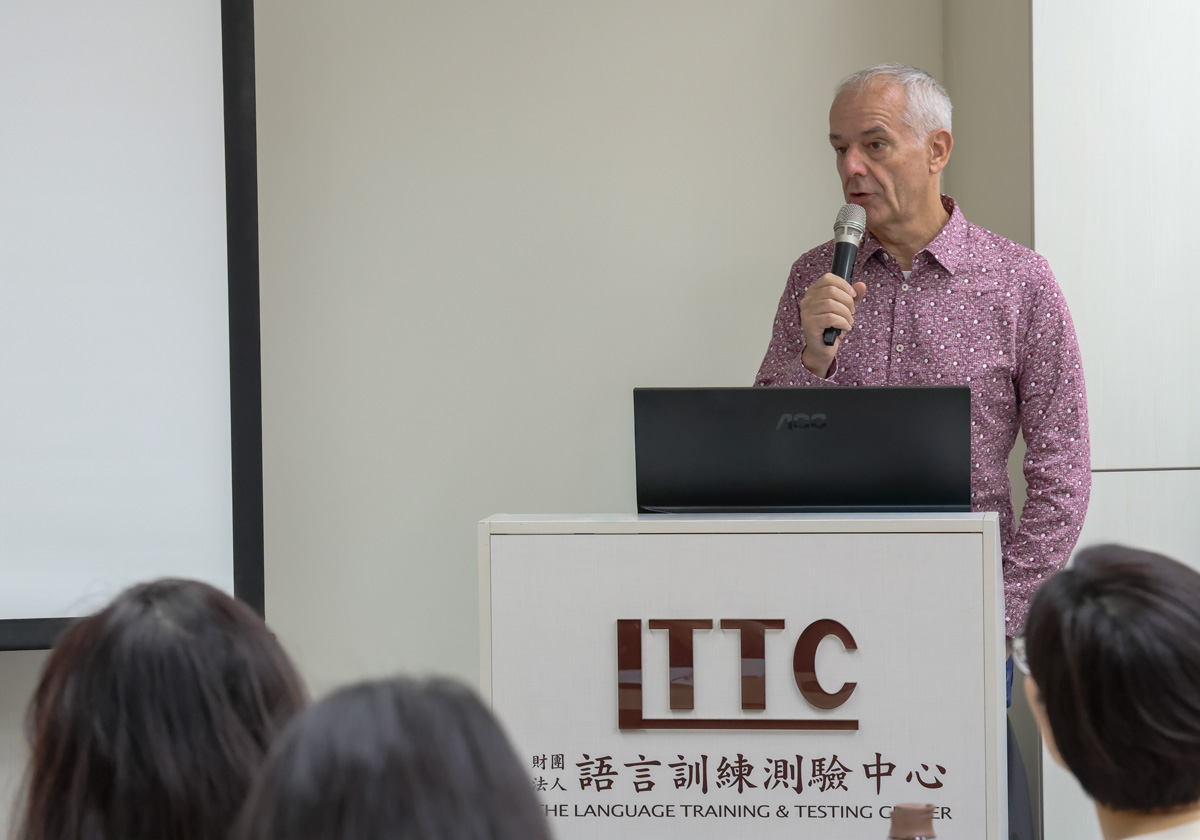
▲Professor Carsten Roever( University of Melbourne, Australia )
During the lecture, Professor Roever pointed out that even second language learners whose proficiency has reached CEFR C1 may still show weaknesses in their interactional competence. In many existing standardized language tests, interactional competence is not explicitly included as part of the assessment construct. One reason is that interactive performance is influenced by cultural factors, the context of the interaction, and the relationship between speakers. In addition, assessment of interactional competence requires substantial resources for item development, test administration, and rating, making both task design and standardization of scoring more challenging. He emphasized that when language tests focus solely on individual language output and overlook the interactive dimension of communication, test results may fail to fully reflect candidates' performance in real-life communicative contexts. He highlighted the need for consideration of interactional competence in the design of test tasks and rating scales.
The lecture also discussed the practical challenges and future directions for assessing interactional competence, particularly in the digital age. Professor Roever noted that interactional competence cannot be easily measured using clear-cut right-or-wrong answers. Furthermore, assessment design involves balancing authentic, real-world contexts with the requirements of standardized testing. Addressing digitally mediated examinations, he touched on recent developments in the use of AI and automated technologies for assessing interactional competence. These include systems that enable dialogue interaction and role-play with virtual interlocutors—such as InteLLA, developed at Waseda University in Japan—as well as ongoing research on automated scoring and feedback.

▲Group photo of the speaker and participants
In closing, Professor Roever shared his vision for the future development of the assessment of interactional competence. He suggested that further research could focus on integrating diverse task types and leveraging technology to improve assessment tasks and feedback mechanisms.

▲Group photo of the LTTC team with Professor Carsten Roever
Third from right : Prof. Hsin-Ying Li, LTTC Chief Executive Officer
Second from right : Dr. Rachel Yi-fen Wu, LTTC Director General for Research and Development