
Bilingual Education
2025.12.12
The LTTC Partnered with the Ministry of Education and BEST Resource Centers to Hold International Conference on Academic English Policy and Practice
Academic English Teaching and Assessment: Policy, Resources, and Future Directions
The international conference EAP/ESAP Curriculum and Assessment: Challenges and Opportunities from Policy to Practice was held to great success on December 6 at the GIS NTU Convention Center. Organized by the Language Training & Testing Center (LTTC) under the supervision of the Ministry of Education (MOE), and co-organized by National Taiwan University (NTU), National Taiwan University of Science and Technology (NTUST), National Chung Cheng University (NCCU), and Southern Taiwan University of Science and Technology (STUST), the conference attracted nearly 150 English curriculum planners, instructors, and scholars. For more information about the event, please visit:https://www.lttc.ntu.edu.tw/BESTEP2025/.
The conference centered on developments related to the BEST Program and the BEST Test of English Proficiency (BESTEP) over the past three years, including test administration, research, and resource development, as well as trends in English for Academic Purposes (EAP), English for Specific Academic Purposes (ESAP), and English-Medium Instruction (EMI) in Taiwan. Three keynote speeches in the morning examined how the BESTEP data can inform teaching and learning. The LTTC shared perspectives on the interaction between assessment and pedagogy; researchers from the University of Melbourne and Tokyo University of Foreign Studies presented ongoing studies on CEFR alignment based on the BESTEP writing samples and the construction of a spoken learner corpus.
-
Four co-organizing universities presented lesson plans showing how the LTTC’s publication EAP Power Up: Synthesizing Textual and Visual Information for Academic Success can be integrated into EGAP and ESAP courses;
- EMI Resource Centers (National Taiwan University, National Taiwan Normal University, National Taiwan University of Science and Technology, National Chung Hsing University, and National Sun Yat-sen University), the Center for Higher Education EMI Professional Development, and Fulbright Taiwan jointly discussed cross-institutional collaboration and student support models.
The conference opened with remarks from LTTC Chairman and NTU President Professor Wen-Chang Chen and MOE Chief Secretary Professor Po-Chiao Lin. Professor Wu-Chang Chang, co-chair of the BESTEP Advisory Committee, served as the closing discussant for the entire event, offering perspectives on future directions for strengthening English language education in higher education—from policy implementation and pedagogical needs to assessment research:
- Sustainable Development of a Teaching–Learning–Assessment Ecosystem Requires Cross-Sector Collaboration
A robust and sustainable higher-education English ecosystem depends on the positive interaction of teaching, learning, and assessment, as well as close collaboration among policymakers, university curriculum planners, instructors, and test developers. For example, analyses of the BESTEP data provide insights into university students’ strengths, weaknesses, and progress over time. These findings inform the development of teaching-learning resources, which are further refined through teacher workshops, information sessions, and discussions with instructors and students. Bespoke collaborative lesson-plan development with university partners also enables assessment to function effectively within a learning-oriented assessment framework. - BESTEP Research Provides Valuable Insights for Teaching and Assessment Development
The growing body of the BESTEP writing and speaking data has become a critical foundation for understanding students’ academic English development. The two international research presentations focused respectively on the construction of a spoken learner corpus and on CEFR alignment. The spoken learner corpus provides emerging evidence of academic English performance across CEFR levels, supports validation of BESTEP scoring, and informs the refinement of proficiency descriptors. It also offers reference points for curriculum and task design and will contribute to the development of future AI scoring models to enhance personalized diagnostic feedback. The CEFR linking study, jointly conducted by test developers and frontline instructors, reveals the two groups’ commonalities as well as the differing perspectives that arise from their respective professional contexts and understandings of learners. These findings highlight the need for localized interpretation when aligning curricula to international frameworks. - From Learning English to Demonstrating Academic Competence
The conference underscored the MOE’s evolving vision for bilingual education: English learning should prepare students for demonstrable competence in academic and professional contexts. MOE Chief Secretary Po-Chiao Lin emphasized in his remarks that the purpose of promoting EAP, ESAP, and EMI instruction is to help students broaden their horizons and connect internationally. He also introduced a new admissions initiative—developed in collaboration with Fulbright Taiwan and several U.S. universities—allowing students who complete designated EMI course to apply without TOEFL. This milestone reflects growing global trust in Taiwan’s EAP and EMI quality, and the BESTEP is expected to play a key supporting role.
Professor Wu-Chang Chang of National Taiwan Normal University noted in his closing remarks that Taiwan’s higher-education sector is developing a healthier ecosystem in which teaching, learning, and assessment continually reinforce one another. The BESTEP data and research findings already serve as invaluable resources. With the advancement of language technologies and AI, along with deepened collaboration among instructors and institutions, these developments will further strengthen Taiwan’s locally-grounded yet globally-aligned approach to academic English education.
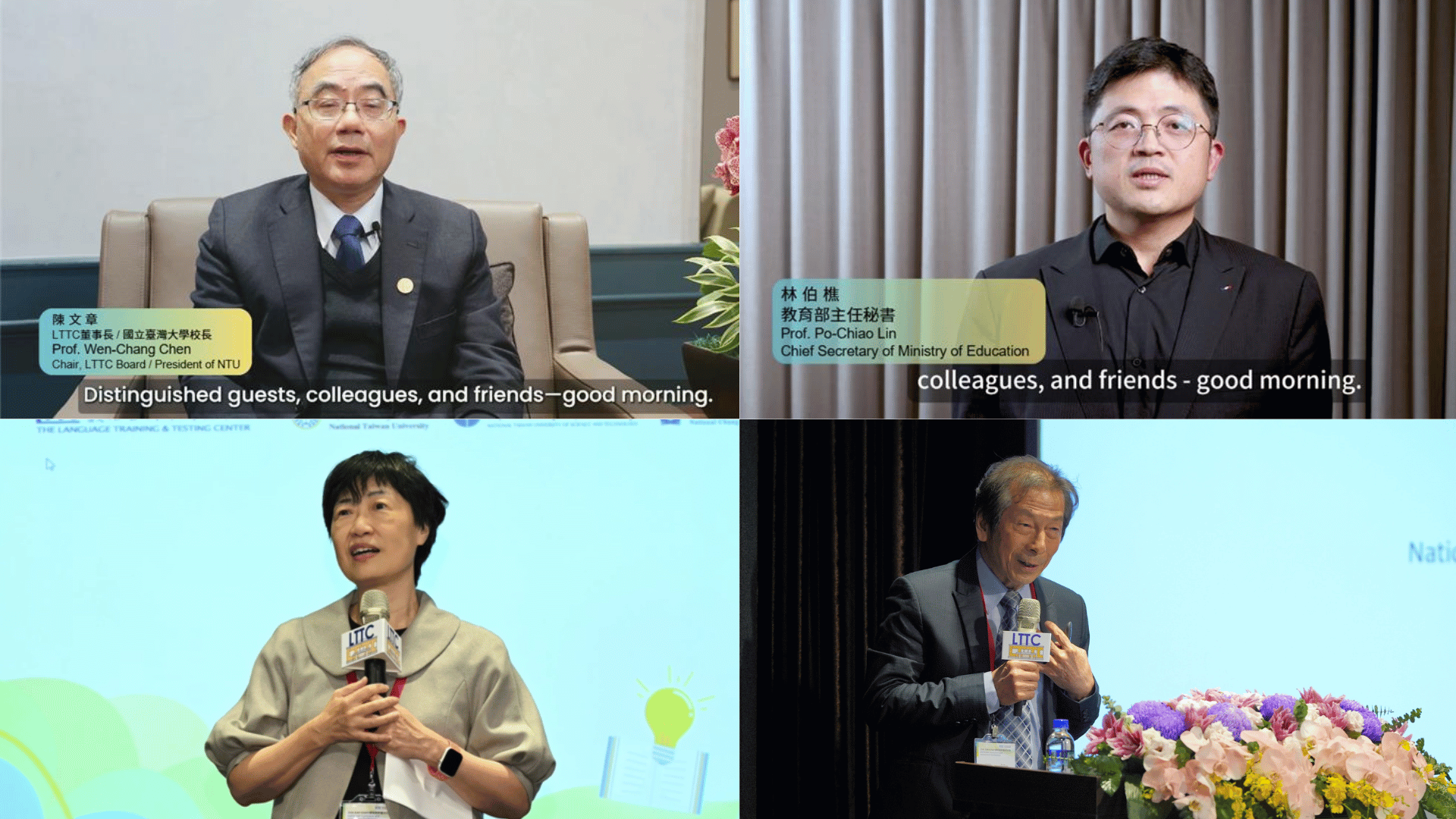
▲ Opening Remarks:
-
Top left : Prof. Wen-Chang Chen, LTTC Chairman and President of National Taiwan University
-
Top right : Prof. Po-Chiao Lin, Chief Secretary, Ministry of Education
-
Bottom left : Prof. Hsin-Ying Li, LTTC Chief Executive Officer
-
Bottom right : Prof. Wu-Chang Chang, Co-Chair of BESTEP Advisory Committee
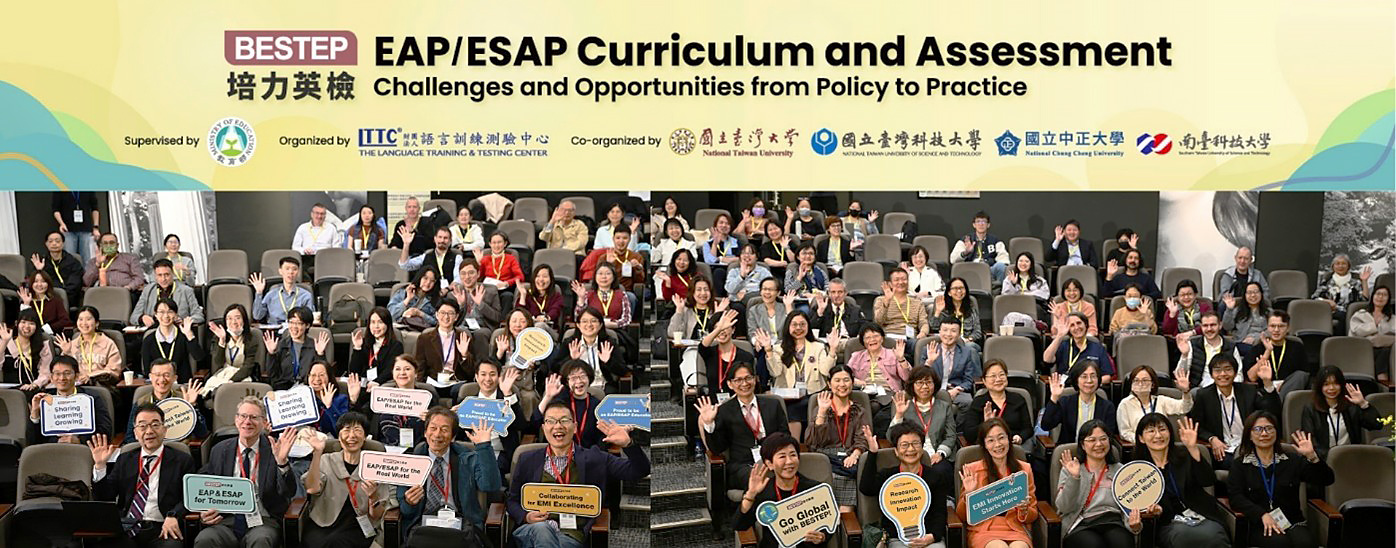
▲ Group Photo of the Conference Attendees
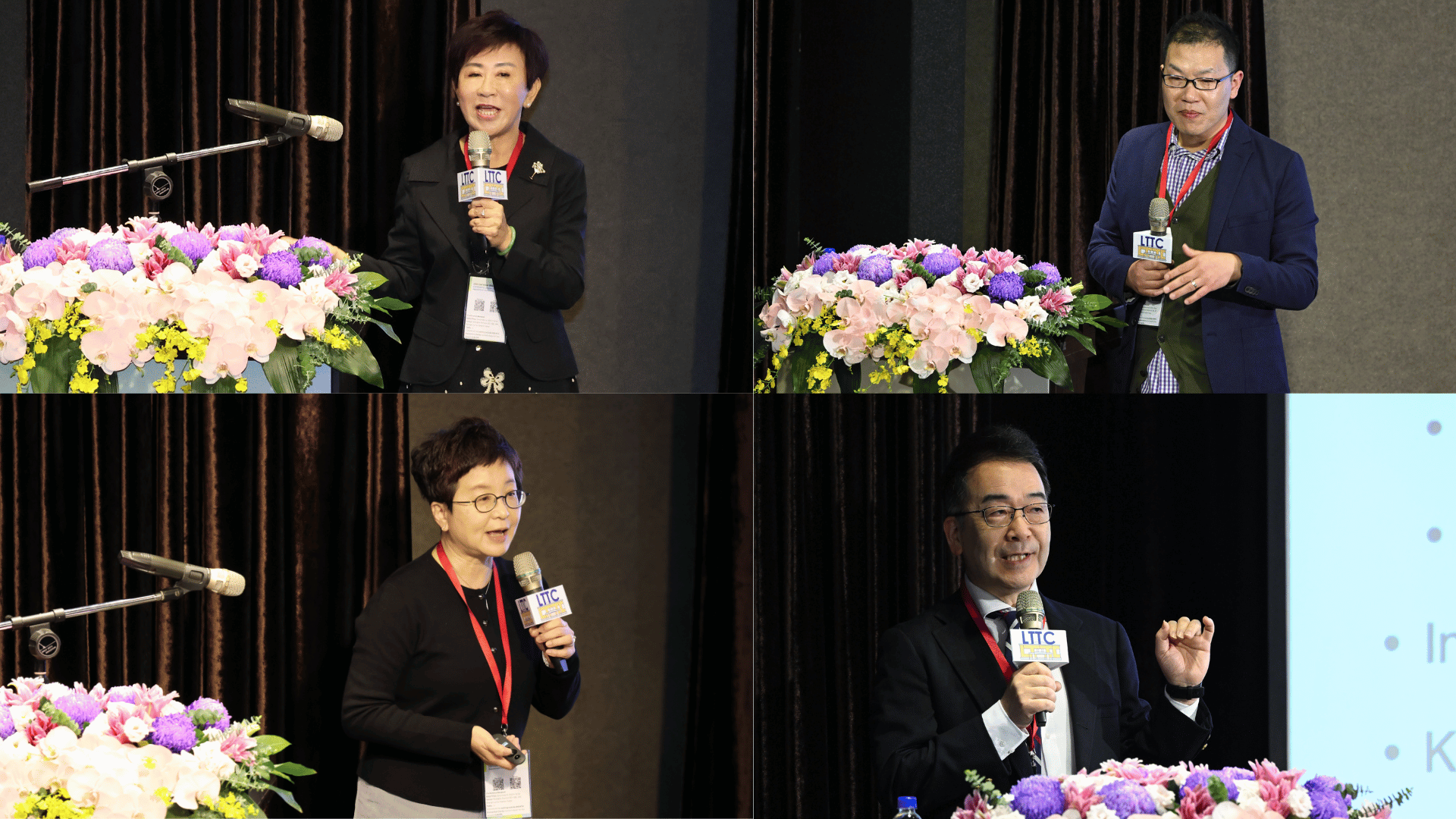
▲ Keynote Speakers:
-
Top left : Dr. Jessica Row‐whei Wu, LTTC Deputy Chief Executive Officer
-
Top right : Prof. Jason Fan, University of Melbourne
-
Bottom left : Dr. Rachel Yi-fen Wu, LTTC Director General for Research and Development
-
Bottom right : Prof. Yukio Tono, Tokyo University of Foreign Studies
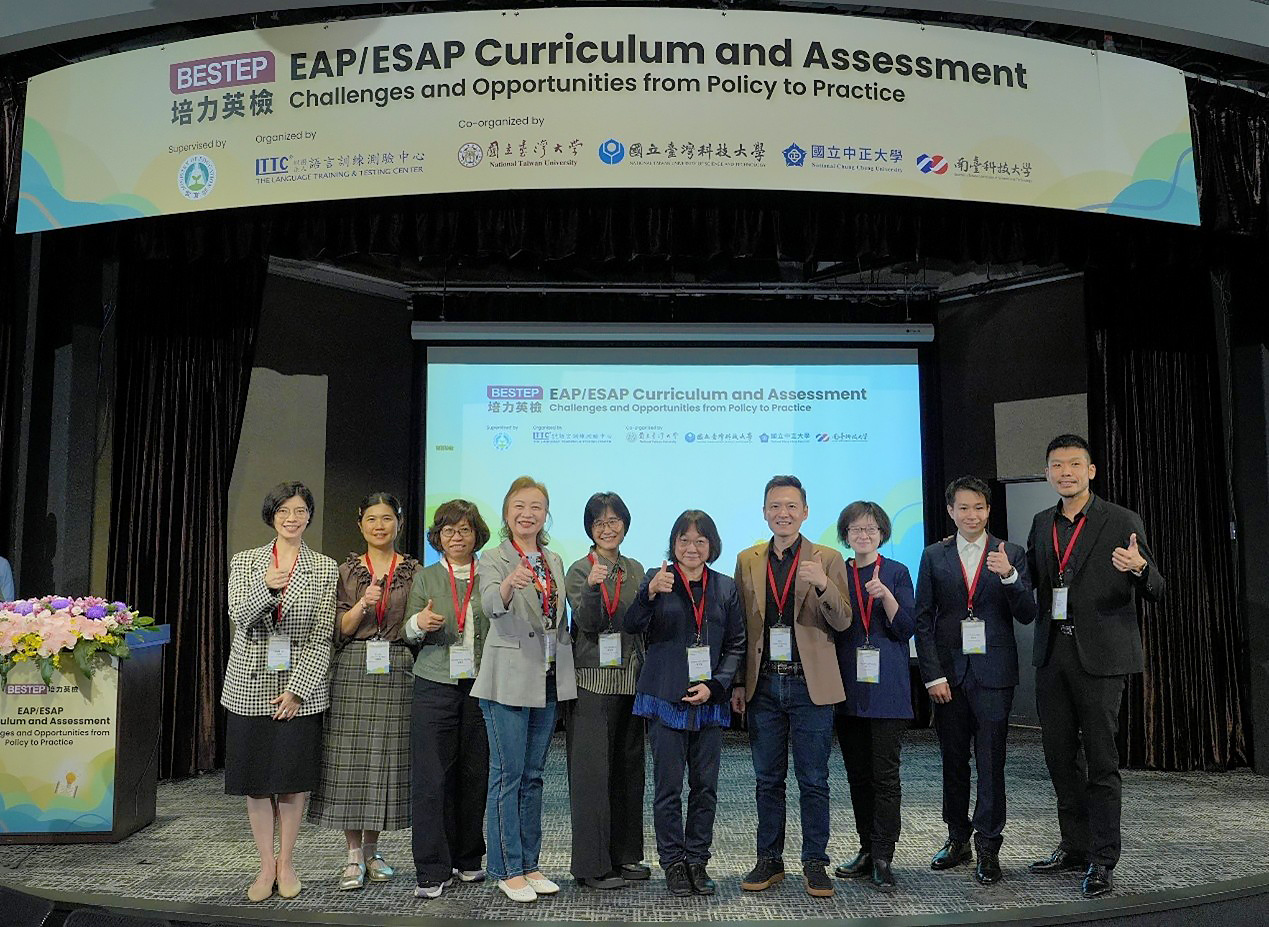
▲ Joint Lesson Plan Presentations:
-
Fifth from right : Prof. Chiou-lan Chern, Department of English, NTNU (chair & discussant)
-
First from right : Lecturer Li-sheng Steve Lee, NTU
-
Second from right : Lecturer Yi-Chi Chen, NTU
-
Fourth from right : Dean Shao-Ting Alan Hung, College of Liberal Arts and Social Sciences, NTUST
-
Third from right : Lecturer Tzu-Ling Huang, NTUST
-
Fourth from left : Director Gina Wen-Chun Chen, Center for Language Studies, CCU
-
Fifth from left : Assistant Prof. Yu-Ning Lai, CCU
-
Third from left : Director Chiung-jung Tseng, Center for Bilingual Education , STUST
-
Second from left : Associate Prof. Hsin-Yi Cyndi Huang, STUST
-
First from left : Director Anita Chunwen Lin, LTTC Teaching and Training Department
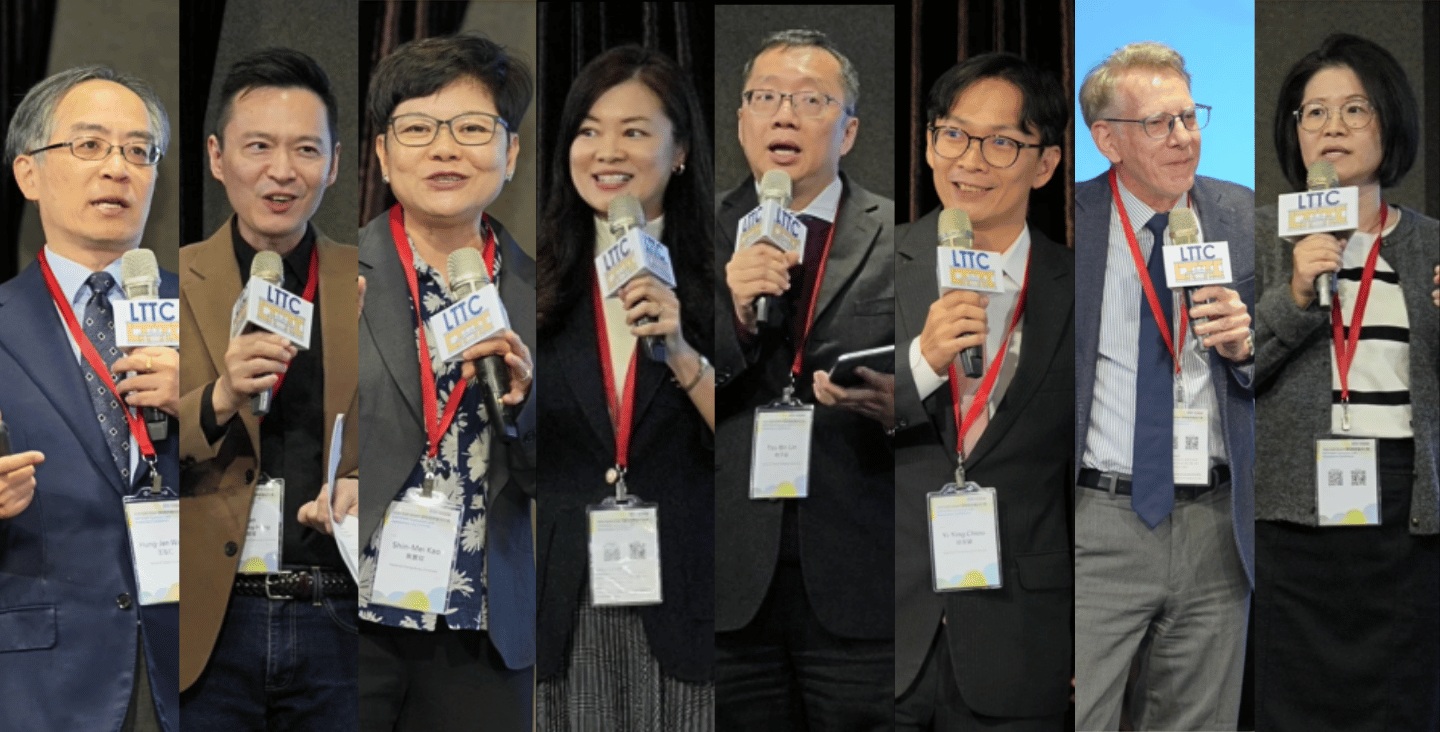
▲ Panel Discussion on the Implementation and Recent Outcomes of the BEST Program Resource Centers
-
Fifth from left : Distinguished Prof. Tzu-Bin Lin, NTNU (chair & discussant)
-
First from left : Vice President Hung-Jen Wang, Academic Affairs, NTU
-
Second from left : Dean Shao-Ting Alan Hung, College of Liberal Arts and Social Sciences, NTUST
-
Third from left : Prof. Shin-Mei Kao, Center for Higher Education EMI Professional Development
-
Fourth from left : Assistant Prof. Yachu Sonya Fan, NTNU
-
Third from right : Associate Prof. Yi-Ying Chiou, NCHU
-
Second from right : Executive Director Randall L. Nadeau, Foundation for Scholarly Exchange
-
First from right : Associate Prof. Shuping Huang, NSYSU
▼ Highlights from the 2025 EAP/ESAP Curriculum and Assessment Conference